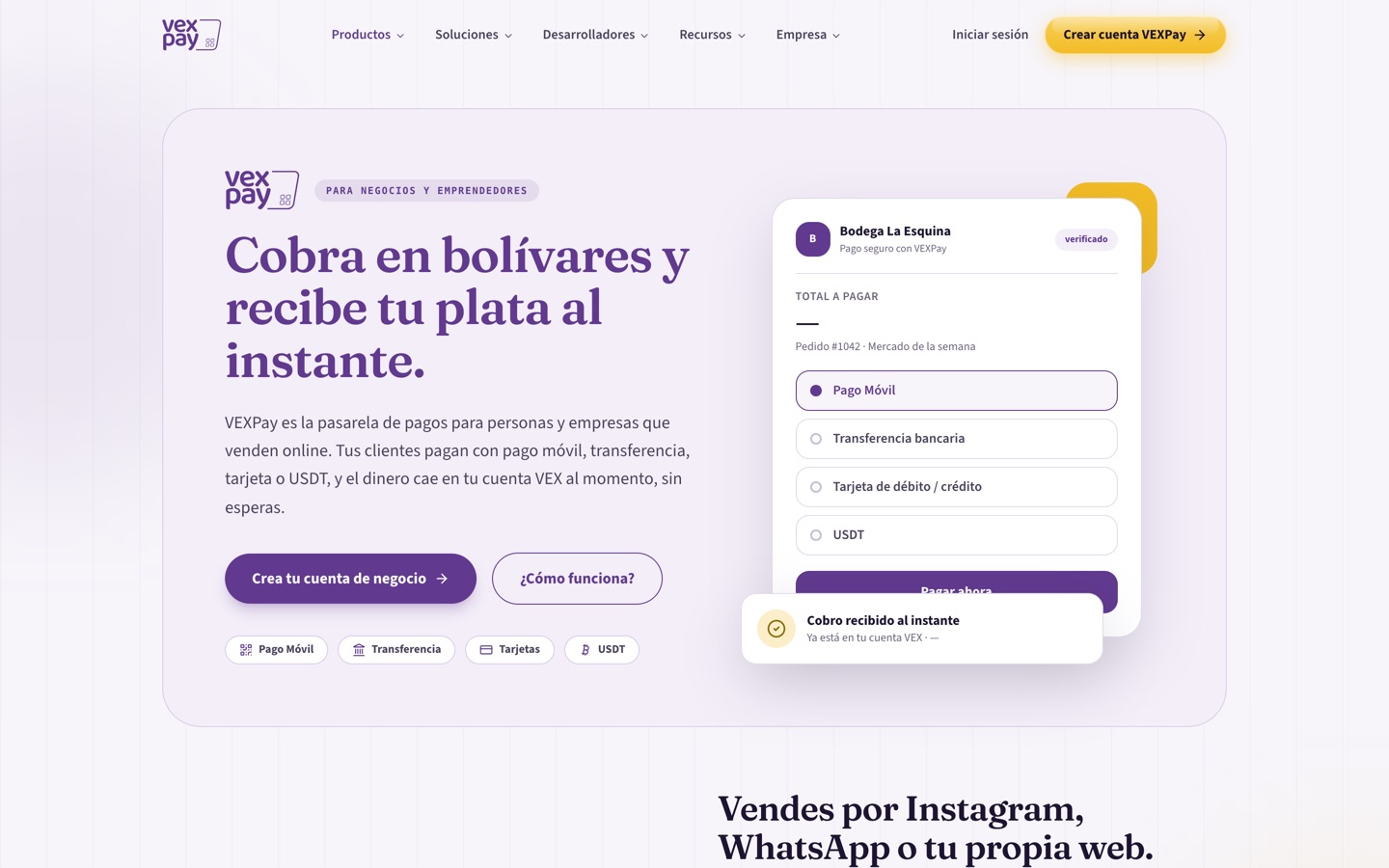
The live home page, captured November 2026.
About VEXPay
- What it is
- Payments API
- Markets
- Venezuela, Colombia
- Status
- Pilot
- Built with
- Next.js, NestJS, PostgreSQL, Supabase, REST APIs
- Live at
- vexpay.app
- Built through
- Chu Ventures
The problem
In Venezuela and Colombia, cards are not the default way money moves. Venezuelans pay in bolívares through Pago Móvil and débito inmediato. Colombians pay in pesos through PSE, Nequi and Bre-B. Many businesses also want to take and pay out USDT. Each of those rails is its own integration, with its own provider.
What VEXPay does
VEXPay puts those rails behind one API, so a business can accept, convert and settle money through a single integration.
In Venezuela it covers Pago Móvil (C2P charges and verification of customer transfers), débito inmediato, VPOS card capture and BCV exchange-rate quotes. In Colombia it accepts pesos through PSE, Nequi and Bre-B. It also runs USDT checkout and payouts.
It is multi-tenant: each business client gets its own API keys and receives signed webhooks.
My role and the stack
I built VEXPay through Chu Ventures as founder and software engineer, owning it from scope to launch. The payments API runs on NestJS and PostgreSQL with Supabase and is exposed over REST. On top of it sit a Next.js site, a hosted checkout and a React Native app built with Expo.
Where it stands
VEXPay is in pilot. Its home page puts the promise plainly: charge in bolívares and get paid instantly.
VEXPay is one of the products I build through Chu Ventures. See it live at vexpay.app, or read my resume.